
A relative pronoun is a pronoun that is used to refer to nouns that have been mentioned previously. The nouns can be people, places, things, animals, or ideas. Relative pronouns can be used to join two sentences.
The most common relative pronouns that are taught to children in the very beginning are as follows:
- Who
- Whose
- Whom
- Which
- That
In some situations, words like “where”, “when”, and “why” are also used as relative pronouns.
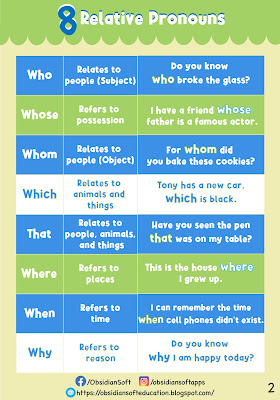
The following chart is a good way of understanding how to use relative pronouns in sentences.
Relative Pronouns Chart:
A relative pronoun is a pronoun that is used to refer to nouns that have been mentioned previously. The nouns can be people, places, things, animals, or ideas. Relative pronouns can be used to join two sentences.
The most common relative pronouns that are taught to children in the very beginning are as follows:
- Who
- Whose
- Whom
- Which
- That
In some situations, words like “where”, “when”, and “why” are also used as relative pronouns.
The following chart is a good way of understanding how to use relative pronouns in sentences.
Relative Pronouns Chart:
Using some relative pronouns might be confusing in the beginning; they require some special attention.
For example, it takes time for children to understand where to use “who” and where to use “whom”.
Who vs Whom:
- “Who” is a subjective pronoun.
- “Whom” is an objective pronoun.
You can only use “who” as the subject of a sentence; the subject is the doer of the action. “Whom” is the object of a sentence. The object is the one that receives the action performed by the subject.
How to check which of these words should be used?
Simply replace “who/whom” with “he/him” or “she/her”. If “he” or “she” would be the correct form, the proper choice is “who”. If “him” or “her” would be correct, use “whom.”
Who ate the last cupcake?
She ate the last cupcake. (correct)
Her ate the last cupcake. (incorrect)
For whom did you paint this?
I painted this for he. (incorrect)
I painted this for him. (correct)
Another confusing pair of relative pronouns is “that” and “which”.
The rule of the thumb is that:
- In a defining clause, use “that”.
- In a non-defining clause, use “which”.
Non-defining clauses provide some additional information that is not essential and might be removed without affecting the meaning of the sentence. They are as disposable as a sandwich bag! Defining clauses have some essential information about the subject and the subject can’t be identified without it.
Non-defining clauses always come between commas.
Examples:
- My books that have red covers are new.
Here, “that have red covers” is a defining clause. We can’t remove it as it gives us essential information and identifies the books.
- My new books, which have black covers, are on the desk.
Here, “which have black covers” is a non-defining clause. It is disposable as it is just extra information about the books that are on the desk.
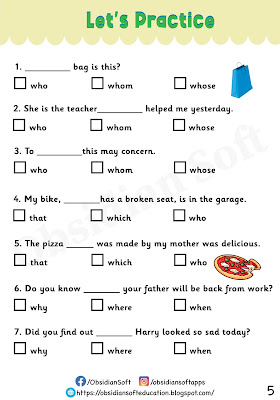
Download the PDF to get all this information in an eBook about relative pronouns. There are also worksheets with an answer key.
Attaching sample worksheet:
Download FREE PDF
I hope you like this effort. Most of my resources are free. Do share it with friends and family if you like my work 😊
Please like my social media pages for more educational resources and tips.
Facebook: https://www.facebook.com/ObsidianSoft/
Instagram: https://www.instagram.com/obsidiansoftapps/
Pinterest:
For links to free educational apps, have a look at the educational apps page
Subscribe to my YouTube Channel for educational videos for coding, mental maths, app development, and phonics: